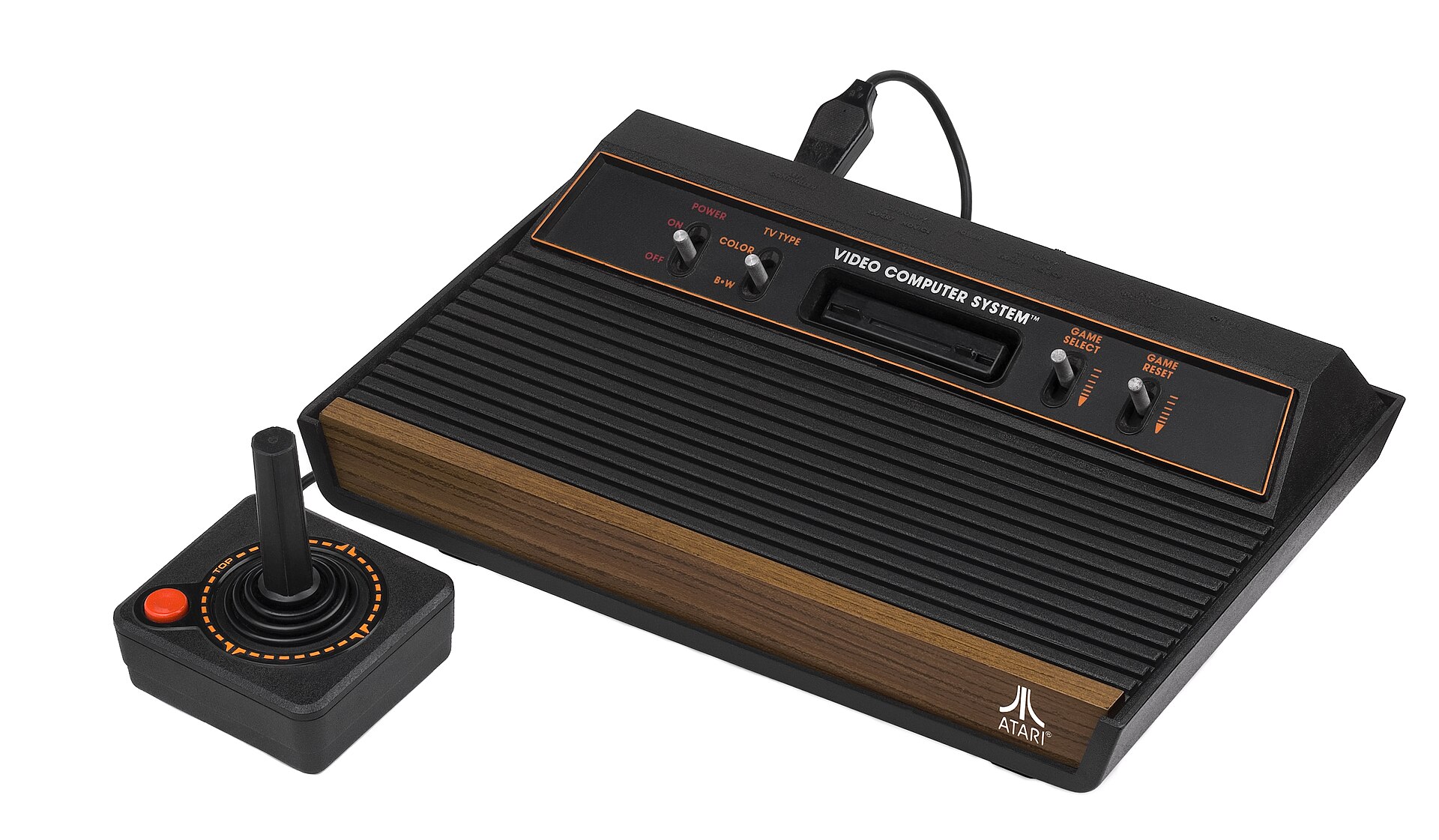
Launched as the Atari Video Computer System in 1977, the machine later known as the Atari 2600 made programmable cartridge consoles a mass-market phenomenon.
At a glance
- Production: 1977–1992, with several case and board revisions.
- CPU: MOS Technology 6507, an 8-bit 6502-family processor at approximately 1.19 MHz on NTSC systems.
- Memory: 128 bytes of internal RAM in the MOS 6532 RIOT chip.
- Graphics and sound: Atari TIA; programmers generate the picture in step with the television beam rather than drawing into a conventional frame buffer.
- Media: ROM cartridge; early titles commonly used 2 KB or 4 KB, while bank switching enabled larger games.
- Controls: digital joystick, paddles, driving controller and specialist accessories.
Why it mattered
The 2600’s longevity came from flexibility rather than raw specifications. Developers learned to manipulate the TIA with cycle-level precision, producing visual tricks the original designers never anticipated. Its library stretches from foundational arcade adaptations to experimental modern homebrew.
Playing today
Stella is the reference-focused emulator for Windows, macOS, Linux and several other platforms. RetroArch’s Stella cores are convenient for living-room builds. A low-power x86 computer, Raspberry Pi 3-class board or modest Android device has ample performance; accurate controller mapping and low display latency matter more than CPU speed.
Starter experiences
Explore different styles: fixed-screen action, paddle games, maze games, early adventures and modern homebrew. Use original cartridges you own, licensed compilations, or public-domain releases.
Image credit: Atari 2600 console photographed by Evan-Amos, public domain, via Wikimedia Commons. Technical reference: Atari 2600/2600A VCS Field Service Manual.
