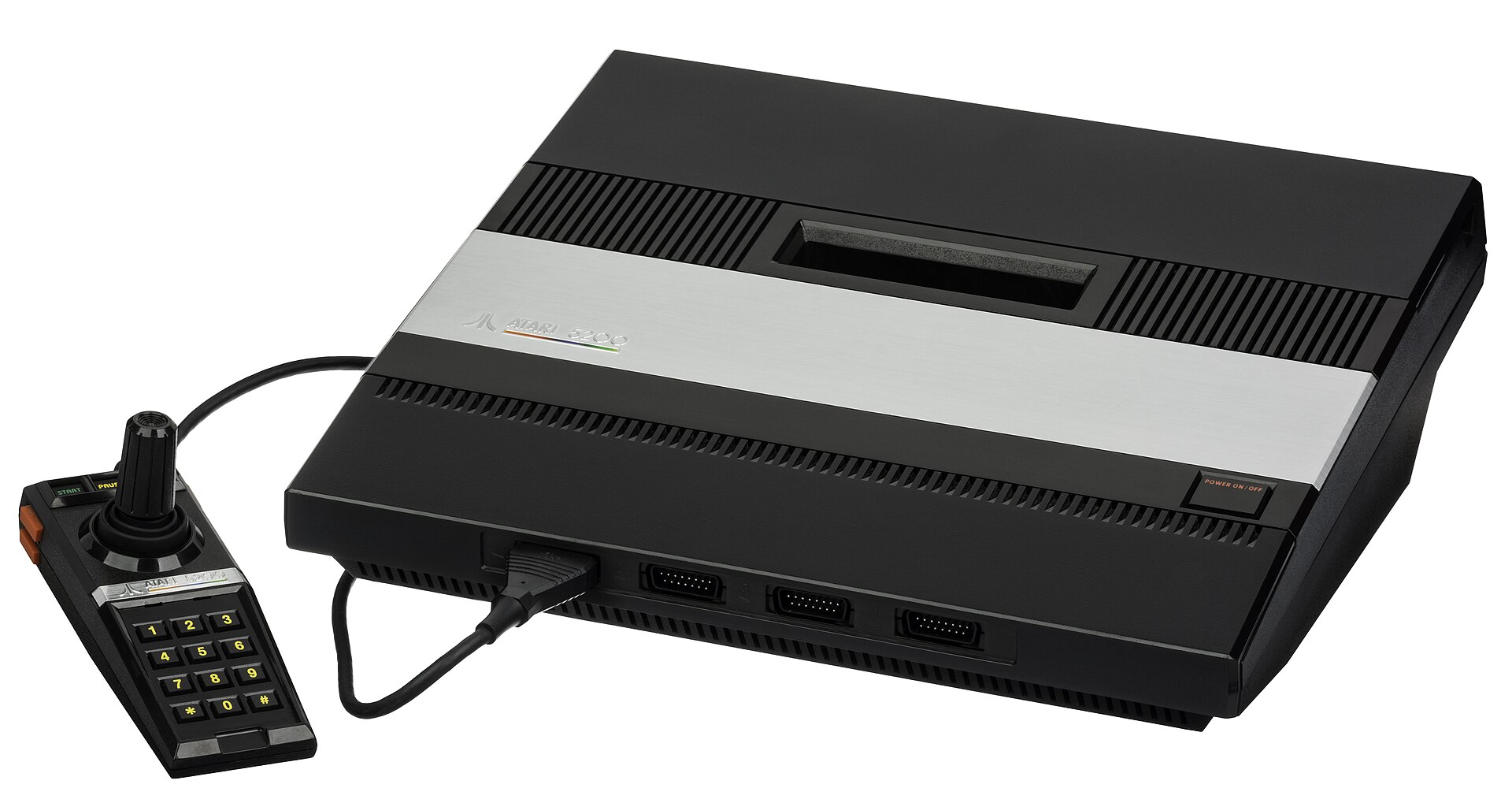
The Atari 5200 SuperSystem arrived in 1982 as Atari’s more powerful follow-up to the 2600. Its architecture was closely related to Atari’s 400/800 computer family, but its software and cartridge connector were not directly compatible.
At a glance
- Production: 1982–1984.
- CPU: Atari/MOS 6502C at approximately 1.79 MHz on NTSC systems.
- Memory: 16 KB RAM.
- Graphics: ANTIC display processor plus GTIA graphics; hardware player/missile graphics and display-list control.
- Sound and input: POKEY handles four-channel sound, controller scanning and other I/O.
- Models: original four-controller-port system and later two-port revision.
The ambitious controller
The analog, non-self-centering controller offered a keypad, pause button and multiple fire buttons. It enabled experiences that simple digital sticks could not, but aging flex circuits and centering behavior remain common restoration concerns. Modern replacement controllers and adapters can make original hardware more approachable.
Playing today
Atari800-derived emulation and compatible RetroArch cores can emulate the 5200 well. Correct BIOS use, controller calibration and per-game keypad mapping are the main setup tasks. A Raspberry Pi 3 or newer, basic x86 PC, or 64-bit Android device is comfortably powerful enough.
Image credit: Atari 5200 photographed by Evan-Amos, public domain, via Wikimedia Commons. Technical reference: Atari CX5200 Field Service Manual.
