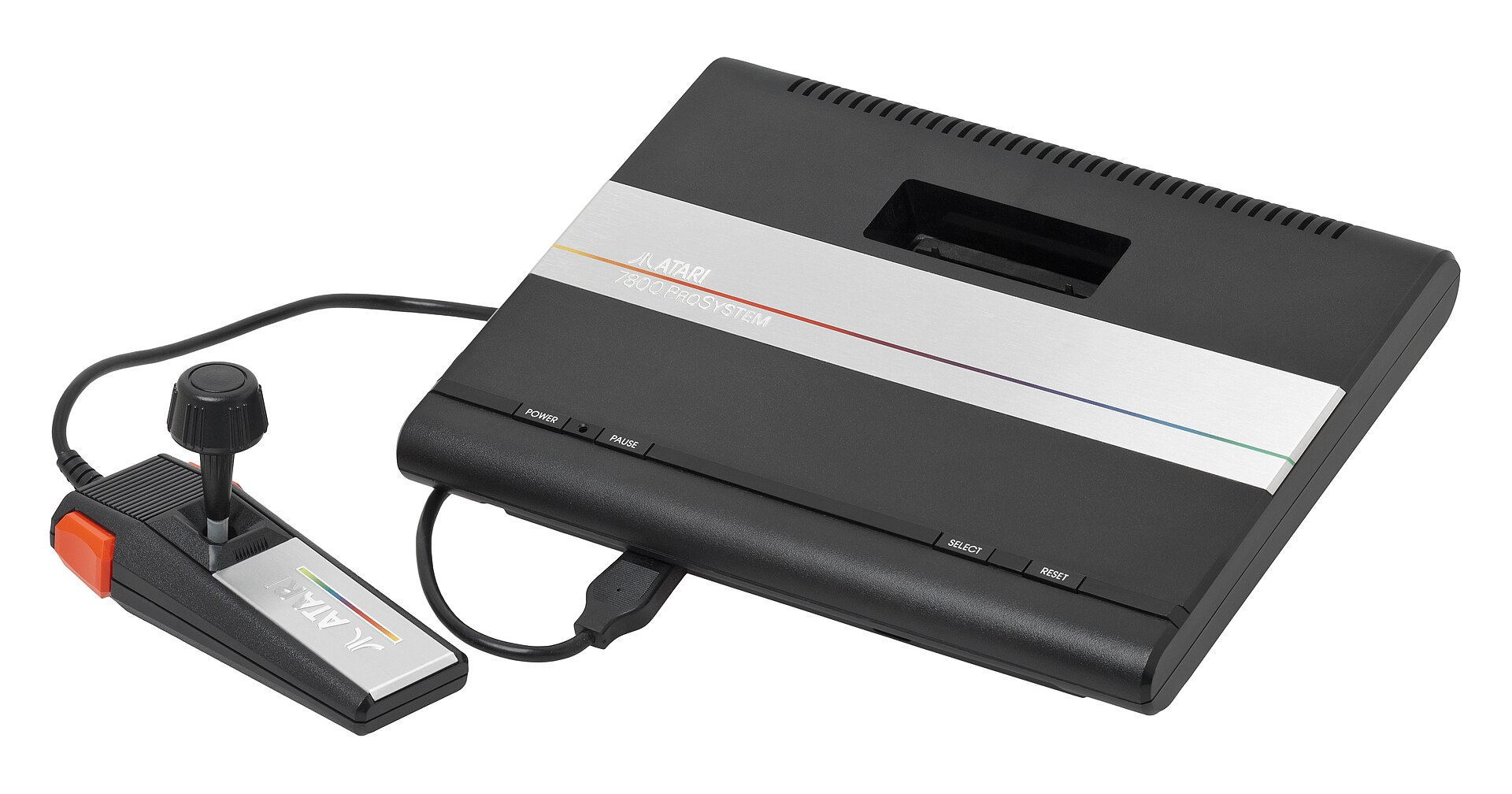
Designed with General Computer Corporation, the Atari 7800 paired a sprite-oriented graphics system with backward compatibility for most Atari 2600 cartridges and controllers.
At a glance
- Production: limited 1984 launch; broad U.S. relaunch in 1986; discontinued in 1992.
- CPU: Atari SALLY, a 6502C-family processor at approximately 1.79 MHz.
- Memory: 4 KB RAM.
- Graphics: GCC MARIA display chip, with modes up to 320 horizontal pixels and a 256-color palette.
- Sound: built-in TIA audio for compatibility; some cartridges added POKEY audio.
- Compatibility: most 2600 software runs through the included TIA and supporting circuitry.
A different road to the arcade
MARIA was built to move many independently positioned objects efficiently, a natural match for arcade-style action. The 7800’s unusual timeline—designed before the 1983 market collapse, then broadly released after Nintendo had reshaped the market—makes it one of gaming history’s most interesting “what if” machines.
Playing today
Modern options include A7800, MAME and the ProSystem family of cores. For best results, use an emulator with active accuracy work and map the two-button controller carefully. Performance demands are modest on x86, Raspberry Pi and Android.
Image credit: Atari 7800 console photographed by Evan-Amos, public domain, via Wikimedia Commons.
