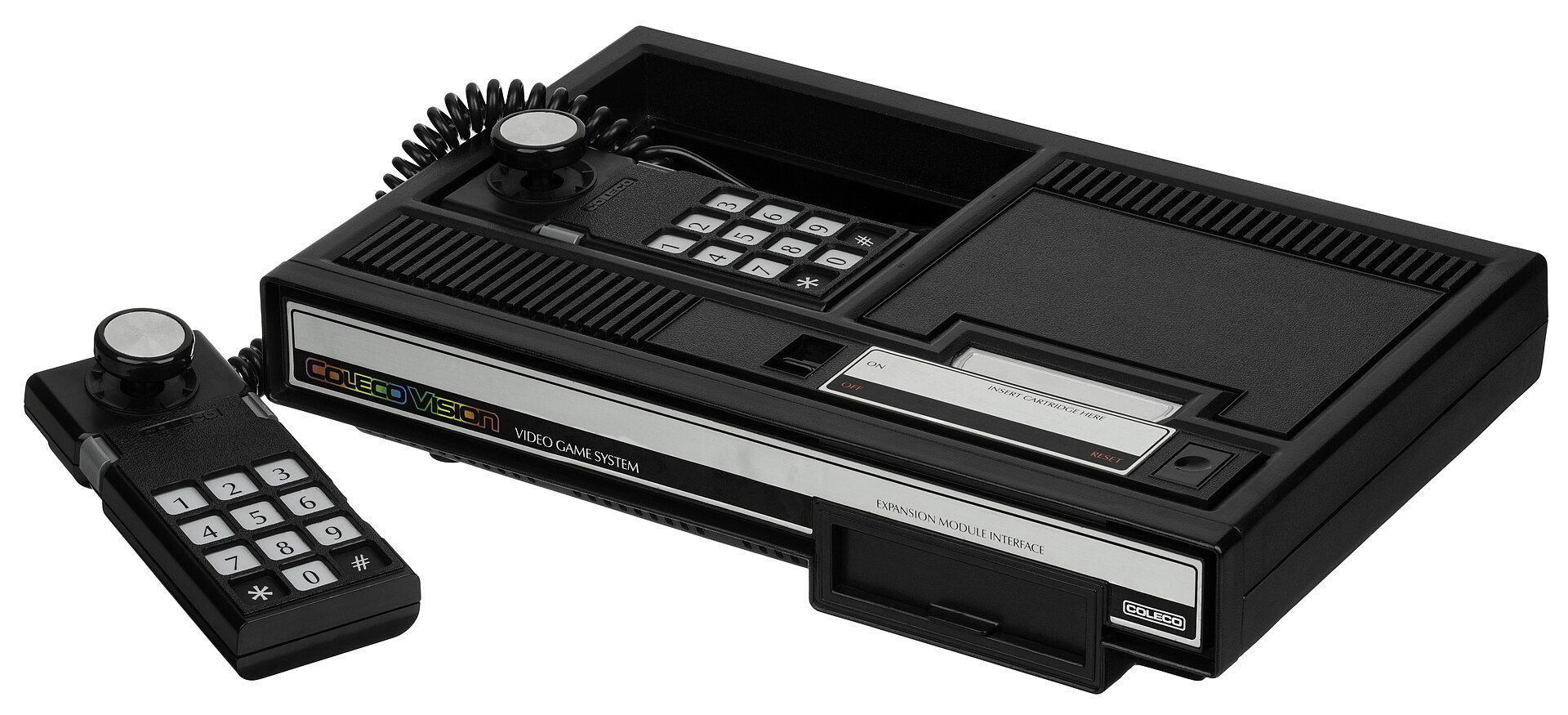
ColecoVision entered the market in 1982 with hardware closely related to contemporary arcade boards and computers, helping it deliver unusually convincing home conversions for its time.
At a glance
- Production: 1982–1985.
- CPU: Zilog Z80A at approximately 3.58 MHz.
- Memory: 1 KB system/work RAM.
- Video memory: 16 KB VRAM dedicated to the Texas Instruments TMS9928A video display processor.
- Graphics: tile and sprite display, typically 256 × 192 pixels with a 16-color palette.
- Sound: Texas Instruments SN76489A programmable sound generator.
- Controllers: joystick, two side buttons and a 12-key numeric keypad that accepts game-specific overlays.
Expansion was part of the pitch
A front expansion connector supported accessories and add-ons. Expansion Module #1 enabled many Atari 2600 cartridges, a notable feature that also became the center of litigation. The Roller Controller and other peripherals broadened the system beyond its standard keypad controller.
Playing today
Gearcoleco, blueMSX, MAME and suitable RetroArch cores are common modern routes. Emulation generally requires a legally obtained ColecoVision BIOS in addition to a game image. Even inexpensive current hardware is sufficient; prioritize a responsive controller and correct 4:3 display scaling.
Image credit: ColecoVision photographed by Evan-Amos, public domain, via Wikimedia Commons. Technical references include the ColecoVision technical/programming documentation.
