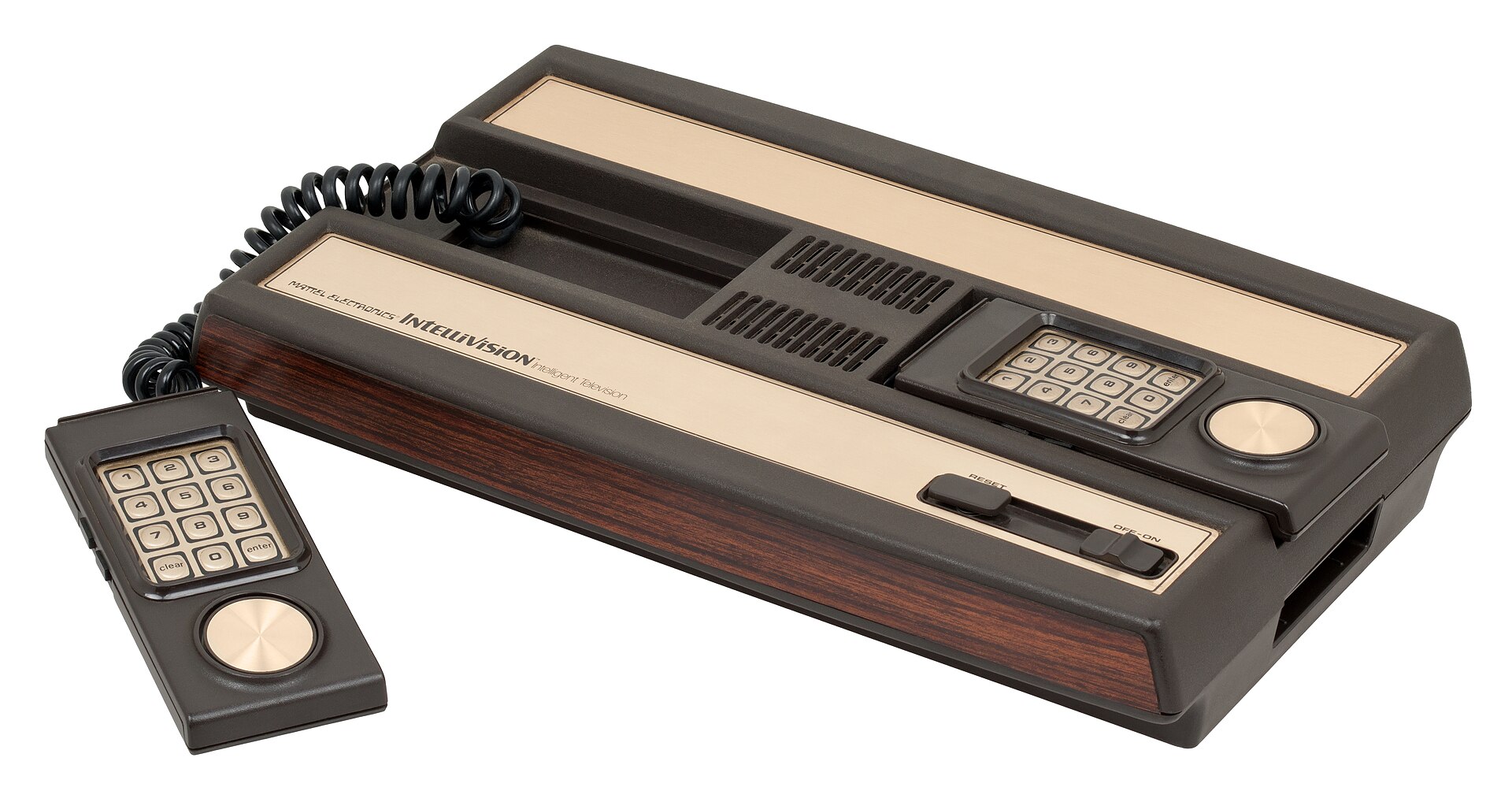
Test-marketed in 1979 and released more broadly in 1980, Mattel Electronics’ Intellivision promised richer visuals, deeper sports games and a sophisticated controller built around a directional disc and numeric keypad.
At a glance
- Production: 1979–1990 across Mattel and successor-branded models.
- CPU: General Instrument CP1610, a 16-bit processor running at approximately 894.886 kHz in the Intellivision.
- Combined RAM: 1,456 bytes: 240 bytes scratchpad, 704 bytes system RAM and 512 bytes graphics RAM.
- Graphics: General Instrument STIC, commonly described as a 159 × 96 logical display with scan-line doubling and a 16-color palette.
- Sound/I/O: General Instrument AY-3-8914 programmable sound generator and I/O.
- Controls: 16-direction disc, four side action buttons and 12-key keypad with overlays.
Sports, strategy and overlays
Intellivision’s sports games often used the keypad overlays to expose more actions than a simple one-button joystick allowed. That complexity gave the system a recognizable identity, but it also means modern controller mapping benefits from an on-screen keypad, keyboard shortcuts or a replica controller.
Playing today
jzIntv, MAME and compatible RetroArch cores are established options. The system’s Executive and graphics ROMs may be required depending on the emulator. Obtain firmware legally from hardware you own or through an authorized package.
Image credit: Intellivision console photographed by Evan-Amos, CC BY-SA 3.0, via Wikimedia Commons. No changes beyond automated import resizing.
